
ÜNDES (Үндес)
Resonance (Echo)
AIGANA GALI
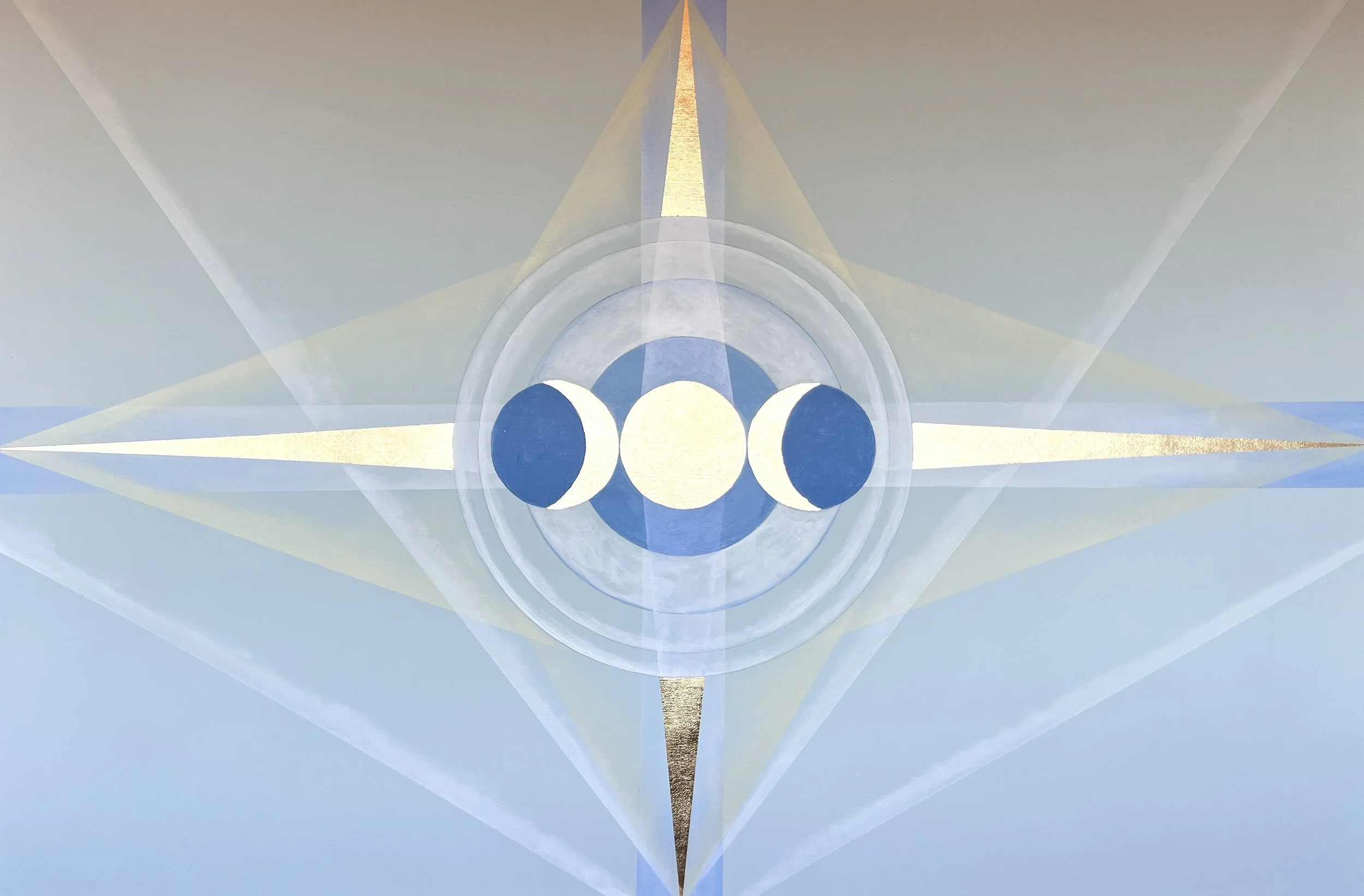
TÜNGIR I | 120 x 180 | Acrylic, Oil On Canvas, Gold Leaf
ÜNDES (ECHO) is Aigana Gali’s third solo exhibition with Kristin Hjellegjerde Gallery, and first in the US. The title comes from the first work in the series, which in Kazakh means resonance; a vibration that passes through matter and meaning alike. ‘This painting arrived like an announcement, almost out of nowhere, and seemed to proclaim that this new series would be about sound, but as I painted, I began to see that they were connected to vibrations. It was not about the music but about the resonance.’ – Aigana Gali From this moment of realization, each work emerged as a meditation on alignment, like a visual echo, symbolic of harmony between human intention a world that reflects it.
When Gali began work on this series, she was preoccupied with the relentless proliferation of AI-generated imagery, isolating individuals – especially young people – in digital echo chambers that reflect only what they want to see. Like the mirrored pool in the Myth of Narcissus, this algorithmic reflection dulls our capacity to experience the living world. We are social beings, we thrive in community and require real, physical connections to grow – and survive. Through the vital act of painting – standing before a raw canvas, mixing pigments, building feeling her way toward form - Gali began to resolve these thoughts. Each mark became a step in an unfolding sequence, an analogue rhythm countering the paralysis of screen time. In their totality, these paintings present an alternative - a re-tuning - like instruments for accessing higher states of awareness.
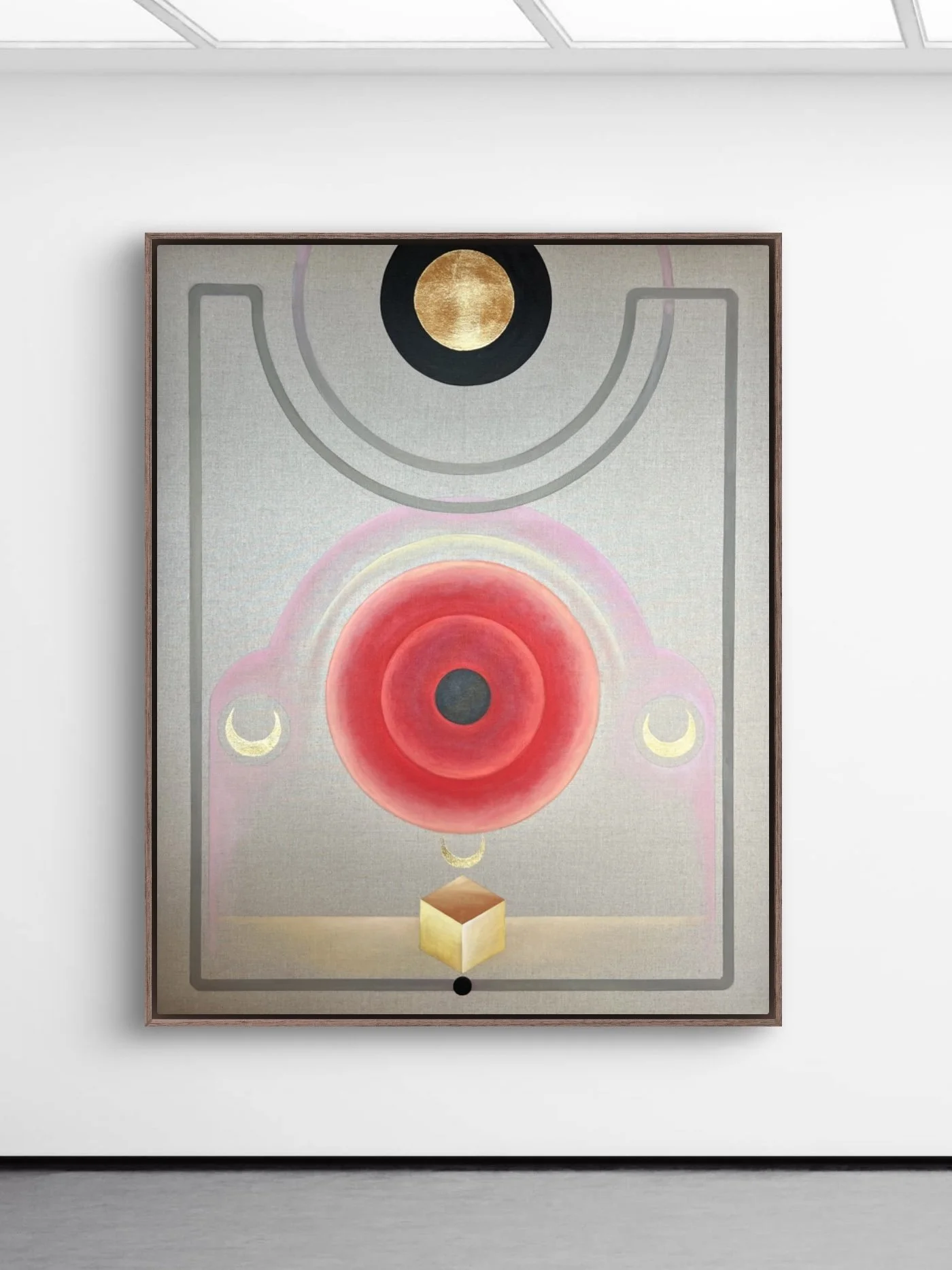
ÜNDES | 160 x 130 | Acrylic, Oil On Canvas, Gold Leaf
“ÜNDES is the law that governs alignment,” says Gali, “when intention is reflected by the world, like an echo.” In her universe of these paintings, Undes is not passive beauty, but moral geometry, an unseen (but felt) architecture in which action and consequence resonate across invisible strings. “It is the quiet tuning of the soul with sky, others, and time.” Her practice is profoundly haptic: through physical manipulation and kinesthetic attention Gali acquires her understanding. In approaching these paintings, we are still yet resonant, and become attuned with the work. “These paintings are meant to be experiential,” says Gali; as we look with intention, we embody and so the experience is transformative.
The interplay between vibration and form recalls Jean-Michel Basquiat’s essential observation: “Art is how we decorate space; music is how we decorate time”. By making the distinction that art shapes space and music bends time, he was also pointing to their co-existence in that both shape our perception. What unites them are vibrations: painting and music, light and tone alter us through their frequencies. In this sense, we can chart the artists recovery through the work from a feeling of despair about artificial isolation towards a sense of love and belonging - of being in the world through making.
In Kazakh, Ün means "sound" or "voice," and the painting UNLIK might be understood as the breath we draw before speech, the shimmer of sound before form. Shaped like a key, we experience this form as receding or hovering on the edge of things. “When you look at UNLIK you see something finished, something you can pronounce, by contrast in ULGEN (the first movement of light) there is the feeling of becoming,” says Gali. There is a sense that we are within an emergent form, looking out from inside the eye or keyhole. This work evokes feelings of tenderness and belonging, as if still held inside the womb, tethered by the umbilical cord. Viewed this way, this series reflects our life’s journey – and work – in searching for true and meaningful connections after this first separation; seeking structure and clarity after the chaos of separation.
“When I look at these paintings now, they feel very instrumental, the visual representation of a tool for spiritual alignment or something… but I also feel silent around them. I do not want to tell people what these paintings mean, I just want them to experience them.” The paintings can be seen as mnemonic tools, visual echoes of a process towards equilibrium, that can attune when experienced.
Distinct from earlier series (Steppe, Tengri, Ex Machina) ÜNDES introduces two striking material presences: unprimed canvas, and the bold use of gold. “Both gold’s purity and reflection are important, I see it working as a kind of conductor, one that creates a vibrational quality within the works” says Gali. The rawness of the canvas that balances this – organic, absorbent and grounding – generating a tension between the earthly and the precious, the elemental and the divine. Gold, found in small pockets across the globe underground, is a metal that never tarnishes, never fades, it shines with atomic purity - waiting to be unearthed.
As a series, ÜNDES recalls sacred sequences one might find in a temple, designed as narrative spaces, frequently employing a sequential, or “journey” layout where imagery becomes increasingly sacred, intimate and exclusive as one moves from the entrance to the innermost sanctum. Unlike ULGEN, OLIARA, BAQSY KOZ or UNDES – which have an almost figurative or corporeal aspect - certain paintings in this series – UNAY, TOGYS, TERBEZ - have an architectural aspect, as if ancient temples aligned to moonlight or planetary rhythms. “UNAY was the second painting in the series, and I struggled a lot with this work, I painted it three times. I feel now that it is a cosmic cathedral according to the phases of the moon.” In giving form to this structure, she creates a theoretical space for us to access the journey as viewers - we just need to be present.
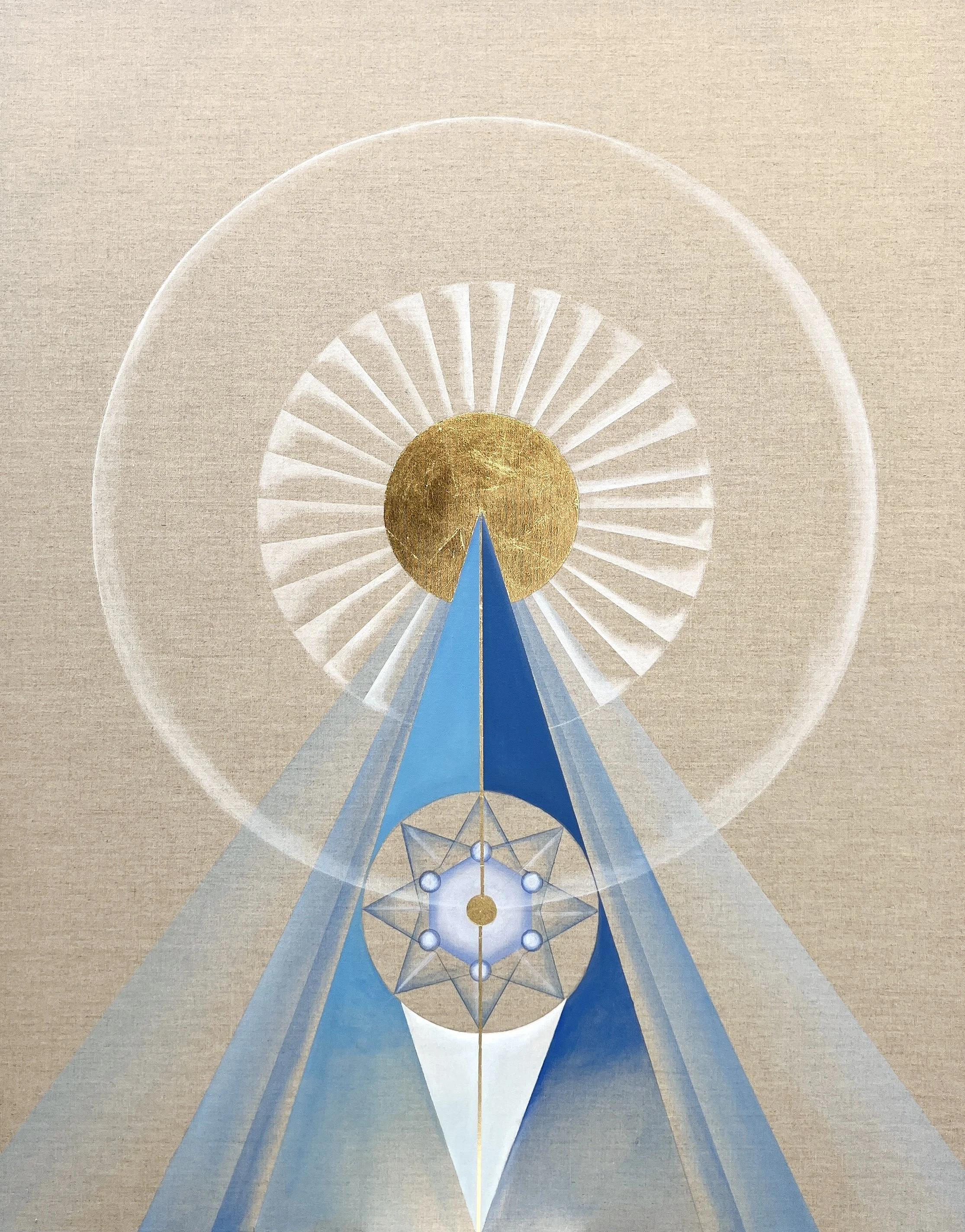
KÜI TAS | 160 x 130 cm | Acrylic, Oil On Canvas, Gold Leaf
Gali often speaks of these works as messages, precise visualisations of something specifically resonant – something felt. To emphasize the idea that these paintings are instrumental, certain works actually reference musical instruments; MANGI and ORDA are circular, suggesting a drum. KÜI TAS is named after a traditional Kazakh instrumental form kui, a melody often played solo — and tas means "stone." “KÜI TAS is a stone that remembers song. It speaks of a world where music was etched into matter, and where every rock holds the memory of vibration. It is the material soul of the steppe — where melody becomes fossil, and form becomes echo.”
There is a painting in the series that seems to unite all these things, a work that is both architectural and instrumental. “TÜNGIR is not sound, but the space that holds sound. It is the dome of the steppe that throws your voice back to you — altered, delayed, instructive. The painting is a sky-instrument, a cosmic room where thought must learn to reverberate before becoming truth.” Like a visual echo chamber, this painting holds our attention with the gold bouncing light between eye and canvas. It invites us to experience something whilst meaning takes shape. There is a simplicity here, but also lasting power. ÜNDES resonates with our current moment, in which we seek respite from the chaos of digital junk; it is an invitation to enter into the real world and give yourself time to feel what you are looking at, and experience being part of this world.
Nico Kos Earle
February, 2026